2026 Best Healthcare Equipment for Global Buyers?

Choosing the right healthcare equipment in 2026 will require more than comparing prices or browsing polished product catalogs. Global buyers must examine clinical value, safety records, supplier reliability, and long-term operating costs. A modern ultrasound system may look impressive, yet its value depends on image quality, software support, staff training, and repair access. Small details matter. A missing cable can stop a department.

Dr. Tedros Adhanom Ghebreyesus, Director-General of the World Health Organization, stated, “Health is a fundamental human right. Every person should have access to the health services they need, when and where they need them, without financial hardship.” His principle offers an important test for every purchasing decision. Does the equipment improve access? Can local professionals use it confidently? Will patients benefit after the warranty ends?

This guide reviews the best healthcare equipment for global buyers through a practical, evidence-aware lens. It considers diagnostic devices, patient monitoring systems, surgical tools, laboratory technology, and essential care products. The focus remains on performance, compliance, maintenance, cybersecurity, and total lifecycle value. Not every expensive device is the best choice. Not every low-cost option is a mistake. Reality is less tidy.

Buyers should also question their own assumptions. A rural clinic may need rugged simplicity, not advanced automation. A major hospital may require interoperability more than another feature. Local electricity, water quality, language, and technician availability can change the outcome. These factors are easy to overlook. They should not be.

2026 Best Healthcare Equipment for Global Buyers?

Healthcare Equipment Categories and Their Global Applications

2026 Best Healthcare Equipment for Global Buyers?

Healthcare Equipment Categories and Their Global Applications

Global buyers need categories that match real clinical settings, not attractive product lists. Diagnostic equipment remains central, because the Lancet Commission on Diagnostics reported that nearly half the world lacks adequate diagnostic access. Portable ultrasound, blood analyzers, and basic imaging systems can support rural clinics, emergency units, and mobile health teams. They need simple interfaces, stable power options, and local calibration support.

Patient monitoring equipment serves intensive care, ambulances, and general wards. Pulse oximeters, vital-sign monitors, and infusion devices reduce observation gaps. However, battery performance changes in hot, humid environments. A specification sheet rarely shows that. The World Health Organization’s 2022 Global Report on Assistive Technology found that more than 2.5 billion people need assistive products, including mobility and communication equipment. Demand will exceed 3.5 billion by 2050.

Rehabilitation and home-care categories are growing with aging populations and chronic disease. Wheelchairs, therapy devices, oxygen equipment, and remote monitoring tools require careful user training. Clinical engineers should review maintenance intervals, spare-part access, cybersecurity, and cleaning procedures before purchase. ISO 13485-based quality systems can indicate controlled manufacturing, but they do not guarantee local suitability. Procurement teams should request field evidence, service records, and independent test results. Sometimes, a less advanced device performs better because staff can repair it quickly. That uncomfortable detail deserves more attention.

Key Buying Criteria for International Healthcare Equipment

For 2026 procurement, the best healthcare equipment is not always the newest model.

Buyers should match performance with local clinical needs, infrastructure, and maintenance capacity. The WHO World Health Statistics 2024 reports that global universal health coverage progress has stalled since 2015. This makes affordability and reliable access practical priorities.

A neonatal monitor that needs stable electricity may fail in a rural clinic. Battery life, voltage tolerance, and manual override options deserve careful review.

Regulatory evidence should be checked before price.
Request certificates, clinical performance data, risk-management files, and clear instructions for use. Confirm whether the equipment meets applicable national requirements and recognized safety standards, such as IEC 60601 for medical electrical equipment.

Cybersecurity also matters for connected devices. The WHO Global Strategy on Digital Health highlights interoperability and data protection as key health-system needs. A device that cannot exchange data safely may create extra work.

The operating environment is easy to underestimate.
WHO and UNICEF’s WASH in Health Care Facilities report found that about one in five facilities lacked basic water services in 2022. Equipment must therefore tolerate cleaning routines, humidity, dust, and interrupted utilities.

Ask about spare-part availability, technician training, calibration intervals, and disposal procedures.

Small details matter. However, no checklist is perfect. Procurement teams may overvalue specifications and undervalue workflow testing. Before large orders, trial the equipment with nurses, technicians, and patients in realistic conditions. Their feedback can expose noise, confusing alarms, or difficult controls that brochures rarely mention.

Essential Medical Devices for Hospitals and Clinics in 2026

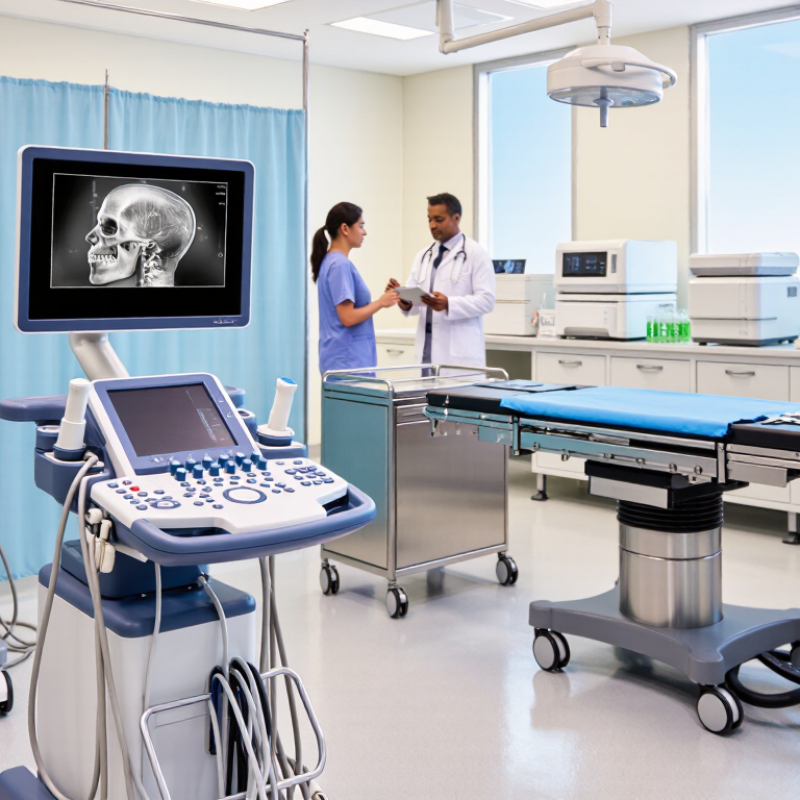
The 2026 healthcare equipment market should prioritize dependable devices that support everyday hospital and clinic work. Patient monitors remain essential for tracking oxygen saturation, blood pressure, temperature, and heart rhythm at the bedside. Compact ultrasound systems can support rapid assessment in emergency rooms, outpatient units, and rural clinics. Portable ECG devices also help clinicians identify abnormal rhythms before symptoms become severe.

Reliable hospitals need more than diagnostic equipment. Infusion pumps should deliver controlled medication volumes and provide clear alarm messages. Ventilators require simple controls, battery backup, and documented maintenance procedures. Sterilizers must handle repeated instrument cycles while recording temperature and pressure data. Laboratory analyzers should offer consistent results, manageable calibration, and secure data transfer. Small details matter.

Procurement teams should examine training needs, spare parts, warranty terms, and local service capacity. A device that performs well in a showroom may fail when voltage fluctuates or staff lack instruction. No device is perfect. Buyers should test equipment in realistic wards, including crowded rooms and emergency conditions. Independent clinical evaluations, recognized safety certifications, and transparent performance records improve purchasing confidence. Yet cost still influences decisions, sometimes too heavily. The cheapest option can create delays, maintenance burdens, or unsafe workarounds later. A practical 2026 strategy balances clinical value, lifecycle cost, cybersecurity, and the needs of actual users.

Quality, Safety, Compliance, and Certification Requirements

2026 Best Healthcare Equipment for Global Buyers?

Quality and safety should guide every healthcare equipment purchase. A polished product is not automatically a dependable one. Buyers should examine material quality, measurement accuracy, electrical protection, cleaning instructions, and expected service life. A device used beside a patient must perform consistently, even during heavy daily use. Check calibration records, test reports, risk assessments, and clear instructions for use. These documents reveal more than attractive product photographs.

Certification requirements depend on the destination market and equipment category. Common references may include ISO 13485 for quality management, ISO 14971 for risk management, and IEC 60601 for medical electrical safety. However, one certificate may not satisfy every national authority. Confirm registration, labeling language, importer responsibilities, and post-market reporting duties before shipment. A certificate alone is not enough. Documentation can be incomplete, outdated, or poorly translated. That uncomfortable detail deserves attention.

Tips: Request sample records before placing a large order. Inspect serial numbers, packaging seals, warranty terms, and replacement-part availability. Ask how complaints are investigated and how corrective actions are documented. Compare the delivered unit with its approved specifications. It is easy to overlook software updates, battery performance, or staff training. That is a mistake. Independent testing may increase cost, but it can prevent unsafe deployment, rejected shipments, and expensive downtime. Certainty is rarely perfect, so record every assumption and review it with qualified local professionals.

2026 Best Healthcare Equipment for Global Buyers? - Quality, Safety, Compliance, and Certification Requirements

A practical comparison framework for evaluating healthcare equipment across international markets.

Equipment Category Core Clinical Function Key Safety Requirements Commonly Applicable Standards Certification or Regulatory Evidence Quality Verification Data Buyer Acceptance Checks Recommended Procurement Priority
Patient Monitors Continuous measurement of vital signs such as ECG, SpO₂, non-invasive blood pressure, temperature, and respiration. Electrical protection, alarm safety, defibrillator protection, measurement accuracy, electromagnetic compatibility, and secure patient connections. IEC 60601-1; IEC 60601-1-2; IEC 60601-2-27; IEC 60601-2-49; ISO 80601-2-61 where pulse oximetry is included. Applicable-market medical-device registration; quality-management evidence under ISO 13485; risk-management file under ISO 14971; conformity assessment appropriate to device classification. Calibration reports, alarm-limit verification, ECG and SpO₂ accuracy testing, battery endurance results, EMC test report, and software verification records. Compare readings with calibrated reference instruments; test audible and visual alarms; inspect cables, probes, battery condition, display visibility, and data export. High
Ventilators Delivery of controlled mechanical ventilation for patients requiring respiratory support. Control of tidal volume, pressure, oxygen concentration, disconnection, occlusion, power failure, and excessive airway pressure. IEC 60601-1; IEC 60601-1-2; ISO 80601-2-12 for critical-care ventilators; ISO 80601-2-80 for home-care ventilatory support equipment where applicable. Market authorization or registration in the destination country; ISO 13485 quality system; ISO 14971 risk management; usability engineering evidence under IEC 62366-1 where applicable. Gas-flow and pressure calibration, delivered-volume accuracy, oxygen-concentration accuracy, alarm-response testing, battery backup results, and preventive-maintenance schedule. Run a simulated-lung test; verify ventilation modes, alarms, oxygen blending, filters, tubing connections, power transfer, and cleaning instructions. Critical
Infusion Pumps Controlled delivery of fluids, medicines, nutrition, or blood products at a programmed rate. Protection against free flow, occlusion, air-in-line, incorrect settings, battery depletion, and unauthorized programming. IEC 60601-1; IEC 60601-1-2; IEC 60601-2-24; IEC 62304 for medical software where applicable; IEC 62366-1 for usability engineering. Destination-market device authorization; ISO 13485 quality system; ISO 14971 risk-management documentation; software lifecycle evidence where software affects safety. Flow-rate accuracy, occlusion-pressure test, bolus-volume test, alarm verification, battery capacity, drug-library validation where included, and cybersecurity documentation for networked models. Test multiple flow rates with calibrated equipment; verify anti-free-flow performance, alarm audibility, lockout functions, keypad response, and cleaning compatibility. Critical
Defibrillators Delivery of therapeutic electrical shocks and, in many configurations, ECG analysis and synchronized cardioversion. Energy accuracy, charging reliability, electrical isolation, ECG interpretation, synchronization, battery readiness, and prevention of accidental shock. IEC 60601-1; IEC 60601-1-2; IEC 60601-2-4; applicable requirements for ECG functions and accessories. Destination-market authorization; ISO 13485 quality-management evidence; ISO 14971 risk file; documented conformity assessment and post-market surveillance process. Delivered-energy measurement, charge-time results, synchronization test, self-test logs, battery-load test, pad shelf-life records, and service calibration history. Use an electrical safety analyzer and defibrillator analyzer; inspect pads and cables; verify self-test, readiness indicator, charging time, alarms, and discharge controls. Critical
Ultrasound Systems Non-ionizing imaging for diagnostic assessment, measurement, and procedure guidance. Electrical safety, acoustic output control, thermal and mechanical index display where applicable, probe integrity, and correct image interpretation. IEC 60601-1; IEC 60601-1-2; IEC 60601-2-37; IEC 62366-1; IEC 62304 where software is safety-relevant. Destination-market device registration; ISO 13485; ISO 14971; electrical and electromagnetic safety reports; software and usability documentation where applicable. Phantom image-quality test, measurement accuracy, probe leakage inspection, electrical safety test, display uniformity, software version control, and data-export validation. Scan a standardized phantom; check depth and distance measurements, probe connectors, image artifacts, presets, DICOM compatibility where required, and disinfection instructions. High
Diagnostic X-Ray Equipment Generation and detection of ionizing radiation for diagnostic imaging. Radiation dose control, shielding, exposure interlocks, image-quality optimization, electrical safety, and operator protection. IEC 60601-1; IEC 60601-1-2; IEC 60601-2-28 or other modality-specific standards; IEC 60601-2-54 for radiography and radioscopy equipment where applicable. Destination-country radiation and medical-device authorization; installation and acceptance testing by qualified personnel; ISO 13485 and ISO 14971 evidence where applicable. kVp and mAs accuracy, exposure reproducibility, dose-area-product verification, leakage-radiation survey, image-quality phantom test, and preventive-maintenance records. Require site-planning documents, shielding assessment, radiation-safety training, acceptance testing, image-quality baseline, and local authority approval before clinical use. Critical
Steam Sterilizers Sterilization of heat- and moisture-resistant medical devices using saturated steam under pressure. Chamber pressure control, temperature uniformity, cycle validation, door interlock, pressure release, water quality, and drying performance. EN 285 for large steam sterilizers; ISO 17665 for development, validation, and routine control of moist-heat sterilization processes; IEC 61010-1 for laboratory and measurement equipment safety where applicable. Installation qualification, operational qualification, and performance qualification; routine monitoring records; local healthcare-facility sterilization requirements. Temperature and pressure mapping, leak-rate test, biological and chemical indicator results, cycle reproducibility, drying test, and calibration certificates. Review cycle printouts or electronic records; perform empty-chamber and loaded-chamber tests; verify door locking, water quality, alarms, and maintenance access. Critical
Medical Refrigerators and Freezers Controlled-temperature storage for medicines, vaccines, reagents, samples, or other temperature-sensitive materials. Stable temperature control, alarm response, power-loss protection, door security, temperature mapping, and prevention of freezing where prohibited. WHO technical specifications where applicable; ISO 13485 only when the product is regulated as a medical device; IEC 61010-1 and relevant refrigeration safety standards according to product design and jurisdiction. Calibration traceability; temperature-mapping protocol; destination-market electrical and product-safety compliance; documented alarm and maintenance procedures. Temperature uniformity, recovery time after door opening, alarm accuracy, power-failure duration, data-logger calibration, and annual mapping results. Conduct a loaded temperature-mapping test; verify high/low alarms, remote notification, door seal, backup power, data export, and storage-capacity claims. High
Surgical and Examination Tables Positioning and supporting patients during examination, treatment, or surgery. Load stability, safe movement, pinch-point protection, emergency lowering, brake performance, patient restraint, and cleanability. IEC 60601-1 for powered medical equipment; ISO 10993-1 for patient-contacting materials where applicable; relevant product-specific requirements in the destination market. Load and stability test reports; electrical safety test for powered models; material and cleaning compatibility evidence; destination-market registration where regulated as a medical device. Static and dynamic load testing, movement repeatability, brake holding force, emergency function test, surface durability, and upholstery seam inspection. Verify rated load, operating range, stability, wheels and brakes, hand controls, battery operation, mattress compatibility, and infection-control procedures. Medium to High
Medical Oxygen Concentrators Production of concentrated oxygen for prescribed respiratory therapy. Oxygen concentration, flow accuracy, overheating protection, oxygen-enrichment fire risk, power failure, alarms, and patient tubing safety. ISO 80601-2-69; IEC 60601-1; IEC 60601-1-2; ISO 14971; IEC 62366-1 where usability affects safe operation. Destination-market medical-device authorization; ISO 13485 quality system; electrical and EMC test reports; risk-management and performance documentation. Oxygen-concentration test at specified flow rates, outlet-pressure test, alarm verification, power-consumption data, filter-life specification, and battery or backup results where fitted. Measure oxygen concentration after warm-up; test low-oxygen and power-failure alarms; inspect filters, tubing, noise level, ventilation openings, and cleaning guidance. High
Networked Clinical Software and Connected Devices Collection, processing, display, storage, or exchange of clinical data and device information. Cybersecurity, access control, data integrity, availability, secure updates, audit trails, backup, interoperability, and protection of personal health information. IEC 62304; IEC 62366-1; ISO 14971; IEC 81001-5-1 for health software cybersecurity; ISO/IEC 27001 may support information-security governance but does not replace medical-device requirements. Applicable medical-device authorization; software classification and technical documentation; cybersecurity risk assessment; vulnerability-management and post-market update process. Penetration-test summary, software bill of materials where available, vulnerability-disclosure process, update history, backup-recovery test, uptime data, and interoperability test results. Verify user roles, encryption, audit logs, secure configuration, offline behavior, data export, interface compatibility, patch procedures, and retention of clinical records. Critical for Connected Systems

Global Buyer Due-Diligence Checklist for 2026

  • Confirm the product’s regulatory classification and market authorization requirements in every destination country before purchase.
  • Request a current declaration of conformity, applicable test reports, product labeling, instructions for use, and a complete technical documentation index.
  • Verify ISO 13485 certification scope, certificate validity, issuing body, manufacturing-site coverage, and whether the certificate applies to the purchased device category.
  • Require calibration certificates traceable to recognized national or international measurement standards, with dates and equipment identification.
  • Evaluate electrical compatibility, local power frequency, plug configuration, environmental conditions, language requirements, and installation constraints.
  • Define acceptance testing, warranty terms, spare-parts availability, preventive-maintenance intervals, training, service response time, and end-of-life support in the contract.
  • For connected equipment, include cybersecurity requirements, software-update commitments, incident-notification procedures, data-protection responsibilities, and interoperability testing.

Note: Standards, certification routes, labeling rules, and registration requirements vary by product classification and jurisdiction. The standards listed above are common reference points and should be confirmed with the competent authority or qualified regulatory professional in the destination market.

Sourcing, Logistics, Installation, and After-Sales Support

Global healthcare equipment buying now depends on more than unit price. Sourcing must verify certificates, electrical standards, spare-part availability, and service records. The World Bank’s 2023 Logistics Performance Index assessed 139 economies and highlighted major differences in shipment speed and supply-chain reliability. A low-cost purchase can become expensive when customs delays, damaged crates, or missing documents stop hospital work.

Logistics planning should define temperature limits, shock protection, insurance, and delivery milestones. Installation needs more than placing equipment in a room. Buyers should confirm power quality, ventilation, water connections, site measurements, and staff training. The WHO’s 2022 global report on infection prevention found that healthcare-associated infections affect about 7 in 100 patients in high-income countries and 15 in 100 patients in low- and middle-income countries. Proper commissioning, cleaning guidance, and maintenance access therefore matter. After-sales contracts should state response times, remote support, preventive maintenance, and spare-part lead times. No sourcing plan is flawless. Local conditions can expose weak assumptions.

Tips: Request a factory acceptance test before shipment. Use photo-based packing records. Ask for installation drawings in advance. Keep critical spare parts locally when possible. Train at least two hospital technicians, not one. Review the first 90 days of service data, including downtime, calibration issues, and unanswered support requests. This evidence can improve the next purchasing cycle.